

Accession number
MS M.1248
Object title
Book of hours fragment (MS M.1248).
Created
Dijon, Burgundy, France, ca. 1480s.
Binding
Modern binding by Denis Gouey. Bookplate on inner cover: “Ex Libris Scott C.Schwartz” his MS. 59.
Credit line
Gift of Dr. Scott C. Schwartz on the occasion of the Morgan's Centennial, 2024.
Description
24 leaves (17 lines), bound : vellum, ill. ; 157 x 111 mm (85 x 55 mm)
Provenance
Mâconnais, a member of the Charnay family, whose arms appear on f. 10v (f. 43v of original manuscript); Louis Lange (name on f. 66v of original manuscript); William Waldorf Astor (1848-1919), first Viscount Astor (his Astor MS A.18); inherited by his son Waldorf Astor, second Viscount Astor (1879-1952); inherited by his son William Waldorf Astor II, third Viscount Astor (1907-1966); deposited at the Bodleian Library shortly before the death of the third Viscount in 1966; sold by order of the Trustees of the Astor Family in London, Sotheby's, 1 December 1987, lot 46; bought by Schuster and Ferrini, broken up at that time; some leaves purchased by Schwartz from Ferrini on 24 March 1990, with the bulk purchased on 18 July 1996.
Notes
Ms. book of hours fragment for the use of Rome; written and illuminated in Burgundy, France, ca. 1480s.
Fragment of a Book of Hours for the use of Rome.
Decoration: Brown ink with red rubrics; brushed gold capitals on blue or red grounds and line-endings throughout; two-line capitals associated with panel borders and bas-de-page miniatures; 6 large miniatures (of 13 in 1987) with full historiated camaïeu d'or borders, 8 large historiated initials (of 16 in 1987) with 3-sided gold frame borders, 33 bas-de-page miniatures (of 91 in 1987), one having been intentionally effaced.
In addition to the fragments of 24 leaves, there are two 15th century flyleaves and two 20th century flyleaves.
Text is fragmented and not in sequential order; included are a prayer to St. Claude; Hours of the Virgin (incomplete); Penitential Psalms 6 and 31 (incomplete); Office of the Dead (incomplete); prayers to Saints Christopher, Ludovico (King Louis IX), Matthew, Sebastian, and Anne.
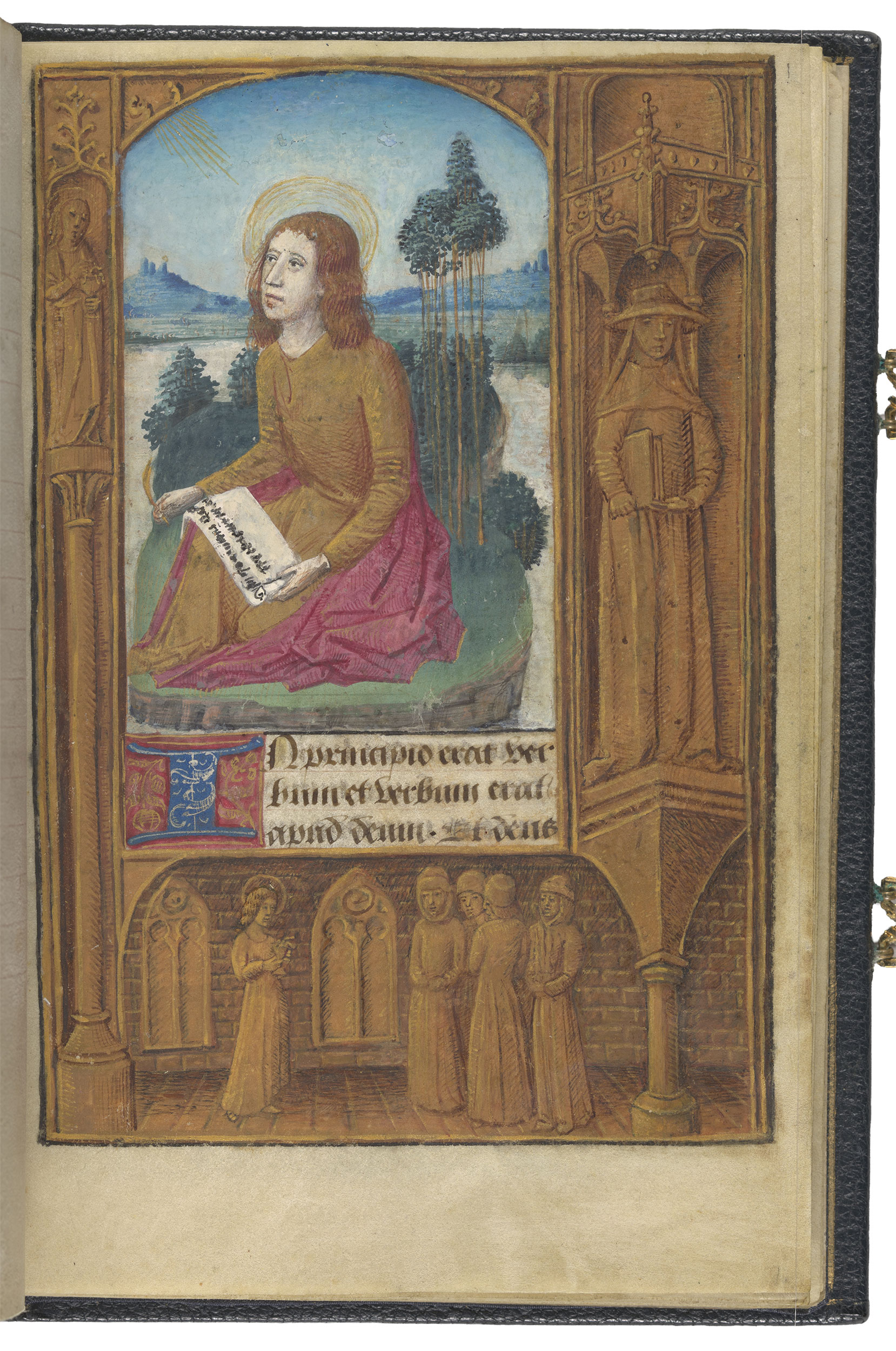
List of illustrations: 1r: John on Patmos; border: John with chalice of snakes and pagan priests; full-length St. Jerome at right. 2v: St. Claude in an historiated initial "O"; border: possible portrait of the original patron. 3r: Annunciation; border: (clockwise from top right) Joachim and Anne at the Golden Gate, Birth of the Virgin, Marriage of the Virgin. 3v: Virgin praying. 4r: Praying man (possibly David). 5r-7r: Man praying; 7v: Cleric praying. 8r: Flight into Egypt; border: Massacre of the Innocents; broken idol on pedestal. 8v: Virgin praying. 9v: Crowned man praying. 10r: Cleric praying. 10v: Coronation of the Virgin; border: angel bearing arms of the Charnay family. 11r: St. Christopher carrying the Christ child. 11v: Man praying. 12r: St. Louis in an historiated initial "D"; border: St. Louis receiving the key to the city of Damietta. 12v: Bishop praying. 13r: Man praying. 13v: Bishop holding infant. 14r: Cleric praying. 15r: Damaged miniature. 15v: Job on the Dung Heap; border: trials of Job. 16r-18v: Man praying. 19v: Shrouded corpse. 20v: St. Matthew in an historiated initial "C"; border: angel; 21r: Virgin and Child. 21v: Crucifixion; border: Betrayal, Christ before Pilate, and Flagellation. 22r: Christ before Pilate(?). 22v: Flagellation. 23r: Crucifixion in an historiated initial "Q"; border: possible patron portrait. 23v: St. Sebastian in an historiated initial "O"; border: Sebastian shot with arrows. 24r: St. Anne in an historiated initial "G"; border: Anne teaching the Virgin. 24v: Young Virgin reading (water damaged) in an historiated initial "S."
Artist: Master of the Burgundian Prelates. Decu Teodorescu and Elsig 2020 distinguish three distinct hands, a master and two family followers, among the works previously attributed to the Master of the Burgundian Prelates. The first Master of the Burgundian Prelates flourished from 1465 to ca. 1473 and produced about thirty manuscripts (including MS M.1200); he might be Jean I Changenet, documented in Dijon from 1449 to 1472/73. The second Master of the Burgundian Prelates flourished from 1475 to 1505 and produced about thirty manuscripts; he might be Pierre Changenet, documented in Dijon from 1477 to 1503-07. The third Master of the Burgundian Prelates flourished from 1480 to ca. 1500 and produced eight manuscripts; he is not identified with any particular member of the Changenet family although he sometimes worked in the shop of the second Master. The Changenet family was thus an important dynasty of painters active in Dijon (and Avignon) from the second half of the fifteenth to the early sixteenth centuries. In Dijon, they flourished from 1465 to 1505. The association of the Dijon Changenet family with the three (especially the second and third) Masters of the Burgundian Prelates rests on the stylistic similarity between their work and that of the painter Jean II Changenet, documented in Avignon, 1485-95. Comparisons can especially be made between their work and the panel of St. Benigne, part of a commission from Jean II Changenet by Nicolas Bouesseau in 1491. Adam and Caron 2021 agree that Jean I Changenet, documented in Dijon from 1449 to 1468 (dead in 1472/73), is the founder of the dynasty. His five or six children included Pierre Changenet, documented in Dijon 1478-1503 (dead before 1507), and Jean II Changenet, documented from 1484-1495. The work of the Master of the Burgundian Prelates, which the authors do not divide into separate groups, is attributed to Pierre Changenet.
The Master of the Burgundian Prelates is named after a group of manuscripts commissioned by Church officials of the Burgundian towns of Langres, Dijon, and Autun. Active from around 1470 to 1490, the artist was based in Dijon.
MS M.1200 was also illuminated by the Master of the Burgundian prelates; both manuscripts were previously in the Astor collection. Sister Leaves are located in: Boston, Boston Public Library MS pb. Med. 236: leaf with shrouded corpse; Chicago, Keegan Goepfert: leaf with portrait of St. Mark; New York, collection of Roger Wieck: leaf with David in Penance.
Fragment of a Book of Hours for the use of Rome.
Decoration: Brown ink with red rubrics; brushed gold capitals on blue or red grounds and line-endings throughout; two-line capitals associated with panel borders and bas-de-page miniatures; 6 large miniatures (of 13 in 1987) with full historiated camaïeu d'or borders, 8 large historiated initials (of 16 in 1987) with 3-sided gold frame borders, 33 bas-de-page miniatures (of 91 in 1987), one having been intentionally effaced.
In addition to the fragments of 24 leaves, there are two 15th century flyleaves and two 20th century flyleaves.
Text is fragmented and not in sequential order; included are a prayer to St. Claude; Hours of the Virgin (incomplete); Penitential Psalms 6 and 31 (incomplete); Office of the Dead (incomplete); prayers to Saints Christopher, Ludovico (King Louis IX), Matthew, Sebastian, and Anne.
List of illustrations: 1r: John on Patmos; border: John with chalice of snakes and pagan priests; full-length St. Jerome at right. 2v: St. Claude in an historiated initial "O"; border: possible portrait of the original patron. 3r: Annunciation; border: (clockwise from top right) Joachim and Anne at the Golden Gate, Birth of the Virgin, Marriage of the Virgin. 3v: Virgin praying. 4r: Praying man (possibly David). 5r-7r: Man praying; 7v: Cleric praying. 8r: Flight into Egypt; border: Massacre of the Innocents; broken idol on pedestal. 8v: Virgin praying. 9v: Crowned man praying. 10r: Cleric praying. 10v: Coronation of the Virgin; border: angel bearing arms of the Charnay family. 11r: St. Christopher carrying the Christ child. 11v: Man praying. 12r: St. Louis in an historiated initial "D"; border: St. Louis receiving the key to the city of Damietta. 12v: Bishop praying. 13r: Man praying. 13v: Bishop holding infant. 14r: Cleric praying. 15r: Damaged miniature. 15v: Job on the Dung Heap; border: trials of Job. 16r-18v: Man praying. 19v: Shrouded corpse. 20v: St. Matthew in an historiated initial "C"; border: angel; 21r: Virgin and Child. 21v: Crucifixion; border: Betrayal, Christ before Pilate, and Flagellation. 22r: Christ before Pilate(?). 22v: Flagellation. 23r: Crucifixion in an historiated initial "Q"; border: possible patron portrait. 23v: St. Sebastian in an historiated initial "O"; border: Sebastian shot with arrows. 24r: St. Anne in an historiated initial "G"; border: Anne teaching the Virgin. 24v: Young Virgin reading (water damaged) in an historiated initial "S."
Artist: Master of the Burgundian Prelates. Decu Teodorescu and Elsig 2020 distinguish three distinct hands, a master and two family followers, among the works previously attributed to the Master of the Burgundian Prelates. The first Master of the Burgundian Prelates flourished from 1465 to ca. 1473 and produced about thirty manuscripts (including MS M.1200); he might be Jean I Changenet, documented in Dijon from 1449 to 1472/73. The second Master of the Burgundian Prelates flourished from 1475 to 1505 and produced about thirty manuscripts; he might be Pierre Changenet, documented in Dijon from 1477 to 1503-07. The third Master of the Burgundian Prelates flourished from 1480 to ca. 1500 and produced eight manuscripts; he is not identified with any particular member of the Changenet family although he sometimes worked in the shop of the second Master. The Changenet family was thus an important dynasty of painters active in Dijon (and Avignon) from the second half of the fifteenth to the early sixteenth centuries. In Dijon, they flourished from 1465 to 1505. The association of the Dijon Changenet family with the three (especially the second and third) Masters of the Burgundian Prelates rests on the stylistic similarity between their work and that of the painter Jean II Changenet, documented in Avignon, 1485-95. Comparisons can especially be made between their work and the panel of St. Benigne, part of a commission from Jean II Changenet by Nicolas Bouesseau in 1491. Adam and Caron 2021 agree that Jean I Changenet, documented in Dijon from 1449 to 1468 (dead in 1472/73), is the founder of the dynasty. His five or six children included Pierre Changenet, documented in Dijon 1478-1503 (dead before 1507), and Jean II Changenet, documented from 1484-1495. The work of the Master of the Burgundian Prelates, which the authors do not divide into separate groups, is attributed to Pierre Changenet.
The Master of the Burgundian Prelates is named after a group of manuscripts commissioned by Church officials of the Burgundian towns of Langres, Dijon, and Autun. Active from around 1470 to 1490, the artist was based in Dijon.
MS M.1200 was also illuminated by the Master of the Burgundian prelates; both manuscripts were previously in the Astor collection. Sister Leaves are located in: Boston, Boston Public Library MS pb. Med. 236: leaf with shrouded corpse; Chicago, Keegan Goepfert: leaf with portrait of St. Mark; New York, collection of Roger Wieck: leaf with David in Penance.
Script
Bâtarde
Language
Latin
Century
Catalog link
Classification
Department